

Pathogenicity of Lipoprotein (a)
Lipoprotein(a) (Lp(a)) resembles an LDL-like lipoprotein with apolipoprotein(a) covalently bound with a disulfide link to apolipoprotein B on the particle surface. Lp(a)’s pro-inflammatory, pro-atherogenic, and pro-thrombotic properties have been linked by Mendelian and epidemiologic studies to myocardial infarction, stroke and peripheral arterial disease. The thrombogenicity is derived from Lp(a)’s structural and functional similarities to plasminogen.1 Further deleterious effects include increased arterial wall cholesterol deposition, chemotaxis of inflammatory monocytes, oxidized free radical and foam cell formation, calcific aortic valvular stenosis, and smooth muscle cell proliferation.2 It is conjectured, that the apolipoprotein(a) prevents binding to the LDL receptor and removal. Prolonged duration in circulation accounts for increased oxidation and smaller particles that may deposit into vascular and valvular structures. Lp(a), is encoded by the LPA gene, with serum levels (normal < 30 mg/dL or 75 nmol/L) being steady throughout life.3 European Society of Cardiology (ESC) guidelines regard Lp(a) as a significant atherosclerotic cardiovascular disease (ASCVD) risk factor once levels exceed the 80th percentile (50 mg/dL or 125 nmol/L).4 Such levels are also considered to be a risk-enhancing factor by the ACC/AHA/Multisociety cholesterol guidelines.5 African Americans have a 3-fold higher median Lp(a) compared to Caucasian populations (75 nmol/L vs 20 nmol/L). As a result, the 80th percentile concentration in African Americans is 150 nmol/L, without evidence to support using a different risk threshold.6 South Asians are also more likely to have elevated levels.7 Chronic kidney disease increases Lp(a) with the highest levels in those undergoing peritoneal dialysis. It is estimated that as much as 20% of the world’s population possess elevated levels of Lp(a). However, in the United States, testing for Lp(a) occurs in only 1% or fewer patients with ASCVD. NLA recommendations have suggested screening in such individuals with ASCVD and ESC guidelines recommend universal screening at least once in the lifetime due to the genetic nature of elevated Lp(a).8,9
Current Treatments for Lp(a)
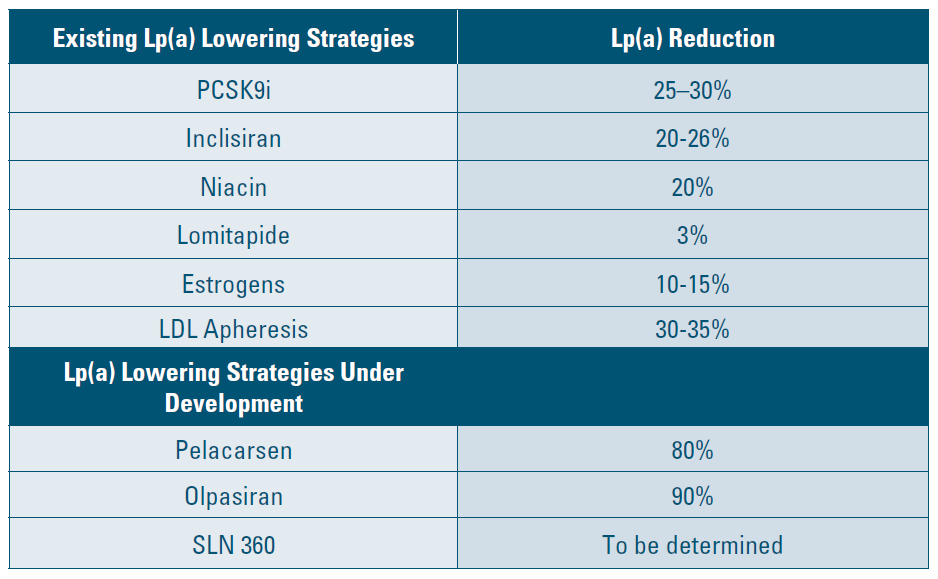
Despite the reported cardiovascular implications associated with elevated Lp(a), there are no approved medications to specifically lower Lp(a) and its risks. Statins (while still recommended in persons with an elevated LDL-C and increased ASCVD risk who have elevated Lp(a)) may increase Lp(a) levels in the general population by 10–20%.1 Niacin causes a 20% reduction with up to a 40% decrease seen in patients with higher baseline Lp(a) levels. Unfortunately, no outcome trials have confirmed that niacin lowers CV risk.10 Estrogen/progestin lowered Lp(a) by 15–20% in a subgroup analysis of the Women’s Health Study (WHS) suggesting benefit 11; however, is not recommended for ASCVD prevention. Although the mechanism of Lp(a) reduction remains unclear, PCSK9 antibody inhibitors, which lower LDL-C levels by 50-60% and Lp(a) levels by about 25% on average, have demonstrated approximately 15% relative reductions in cardiovascular events.2 In a spline analysis of the Odyssey Outcome data, Schwartz et.al. revealed Alirocumab improved MACE even in those with lower LDL-C.12 Lipoprotein apheresis, the only FDA-approved Lp(a) treatment, reduces Lp(a) by 30 – 35% in patients inadequately treated with medical therapy. Although there are no randomized clinical trials to support reduction in cardiovascular events, observational studies in very high-risk patients undergoing lipoprotein apheresis suggest up to a 90% reduction in event rates.13-15
Inclisiran, a small interfering RNA (siRNA), is now FDA approved for patients with ASCVD or heterozygous familial hypercholesterolemia who need further LDL-C lowering, downregulates hepatic production of PCSK9. When administered as a subcutaneous injection every 6 months, Inclisiran provides time-averaged reductions in LDL-C of approximately 50% and also reduces Lp(a) by 20-25%. Outcome trials are pending.16,17
Treatments Under Investigation
Genetically directed medications under development include Antisense Oligonucleotides (ASO) and siRNAs targeting the LPA gene. They provide a highly specific modality for Lp(a) lowering. Through the advent of N-acetylgalactosamine conjugation (gal-NAC), dose reduction and more efficient hepatic uptake promise increased tolerability and decreased complications.
Pelacarsen, also known as AKCEA-APO(a)-LRx or TQJ230, is a hepatocyte-directed ASO targeting the LPA mRNA. A phase 1 trial with 112 patients on single or multiple doses of subcutaneously injected Peliacarsen vs placebo showed Lp(a) lowering without significant complications. The phase 2 trial,18 enrolled 286 subjects with ASCVD and screening levels of Lp(a) > 60 mg/dL or 150 nmol/L. Patients were excluded with major cardiac surgery or stroke, major non-cardiac surgery or lipoprotein apheresis or acute coronary syndrome within 3 months, or BP>160 mmHg or CKD>3. Cohorts received 20, 40, or 60 mg every 4 weeks or 20 mg every two weeks or every week or placebo subcutaneously for 6 to 12 months. The primary endpoint was the percentage change of Lp(a) from baseline to months 6 and 27 as measured by an isoform-independent assay. A dose-dependent Lp(a) lowering with up to an 80% reduction seen in the highest dosing (20 mg weekly equivalent to 80 mg monthly) with 97% achieving an Lp(a) < 25 nmol/L from a median baseline of 224.3 nmol/L. Few adverse effects except for injection site reactions were noted with no significant differences between study drug and placebo for platelet counts, liver or renal measurements or influenza-like symptoms.
A phase 3, randomized clinical outcomes trial, Horizon, will assess Pelacarsen versus placebo on time to first major adverse cardiac event (MACE) in those with Lp(a) >70 or 90 mg/dL.19 Enrollment criteria include an ASCVD including symptomatic peripheral artery disease or an ASCVD event (myocardial infarction or cerebrovascular accident) which occurred more than 3 months but less than 10 years ago and Lp(a) ≥70 mg/dL. Exclusion criteria include uncontrolled hypertension, heart failure New York Heart Association (NYHA) class IV, history of malignancy of any organ system, history of hemorrhagic stroke or other major bleeding, platelet count ≤LLN, active liver disease or hepatic dysfunction, “significant” kidney disease, and pregnant or nursing women. Subjects receive a subcutaneous injection of 80 mg Pelacarsen or placebo monthly. The planned duration of this study is 4.25 years or until the occurrence of 993 MACE. In August 2021, the study announced 50% enrollment of its projected 7,680 patients with anticipated completion in or beyond 2025.
In the Phase 1 study 20 of Olpasiran, (AMG890), a GalNAc-conjugated siRNA developed in conjunction with Arrowhead Pharmaceuticals subjects received a single dose in 3:1 randomization of 3, 9, 30, 75, and 225 mg of AMG 890. Cohorts 1-5 had Lp(a) >70 and <199 while cohorts 6-10 had Lp(a) >200 nmol/L. In cohorts 1-5, doses of AMG > 9 mg/kg SQ reduced Lp(a) 75-96% at day 43 and 80-94% at day 113. In cohorts 6-10, Lp(a) reduction amounted to 75-89% at day 43 and 61-80% at day 113. The most common treatment adverse events were headache (10 vs 25%) and upper respiratory infection (15 vs 13%) with AMG 890 vs placebo; no safety concerns were identified.
In July 2020, a Phase 2 double-blind, randomized, placebo-controlled trial of Olpasiran began investigating the safety and efficacy in 281 subjects from the US and Japan. Patients were enrolled with baseline levels of Lp(a) > 150 nmol/L and atherosclerotic cardiovascular disease, but excluded for chronic kidney disease >4, hepatic disease, lipoprotein apheresis, PCSK9 inhibitor or niacin therapy. They were randomized 1:1:1:1:1 to 4 different doses tested against placebo. The primary endpoint compares Olpasiran to placebo for percent change in Lp(a) at intervals of 3 months until 48 weeks. Study coordinators anticipate completion in 2023.
SLN 360 from Silence Therapeutics is a siRNA directed at Lp(a) RNA to decrease Lp(a) production. A phase 1 trial with 88 subjects is underway and expected to conclude in November 2022.
Summary
The genetically determined, highly atherogenic LDL-like particle, lipoprotein(a) increases cardiovascular risk. No currently available therapies that lower lp(a) have been demonstrated to lower ASCVD events beyond statin therapy nor are indicated to lower ASCVD risk. Traditional lipid-lowering strategies against Lp(a) have yielded only marginal results beyond the benefit associated with LDL reduction. Given that one-fifth of the population is thought to be affected, a vast need still remains for targeted therapies that are not only efficacious but safe and tolerable. The safety of targeted therapies to drastically reduce Lp(a) levels with ASO and siRNA therapies remains to be determined. Pelacarsen, Olpasiran, and SLN 360 results from phase 1 and 2 trials suggest that these may be tolerable options for reducing Lp(a) levels. Outcome trials will determine which patients may benefit from them.
Disclosure statement: Dr. Oates has no financial disclosures to report. Dr. Trippi has received honoraria from Esperion, Kaneka, Regeneron, and Amgen.
References
- Tsimikas S, Gordts PLSM, Nora C, Yeang C, Witztum JL. Statins and increases in Lp(a): an inconvenient truth that needs attention. Eur Heart J. 2020;41(1):192-193. doi:10.1093/eurheartj/ehz776
- Tsimikas S. A Test in Context: Lipoprotein(a): Diagnosis, Prognosis, Controversies, and Emerging Therapies. J Am Coll Cardiol. 2017;69(6):692-711. doi:10.1016/j.jacc.2016.11.042
- Ward NC, Kostner KM, Sullivan DR, Nestel P, Watts GF. Molecular, Population, and Clinical Aspects of Lipoprotein(a): A Bridge Too Far?. J Clin Med. 2019;8(12):2073. Published 2019 Nov 27. doi:10.3390/jcm8122073
- Catapano AL, Graham I, De Backer G, et al. 2016 ESC/EAS Guidelines for the Management of Dyslipidaemias. Eur Heart J. 2016;37(39):2999-3058. doi:10.1093/eurheartj/ehw272
- Grundy SM, Stone NJ, Bailey AL, et al. 2018 AHA/ACC/AACVPR/AAPA/ABC/ACPM/ADA/AGS/APhA/ASPC/NLA/PCNA Guideline on the Management of Blood Cholesterol: A Report of the American College of Cardiology/American Heart Association Task Force on Clinical Practice Guidelines [published correction appears in Circulation. 2019 Jun 18;139(25):e1182-e1186]. Circulation. 2019;139(25):e1082-e1143. doi:10.1161/ CIR.0000000000000625
- Wilson DP, Jacobson TA, Jones PH, et al. Use of Lipoprotein(a) in clinical practice: A biomarker whose time has come. A scientific statement from the National Lipid Association. J Clin Lipidol. 2019;13(3):374-392. doi:10.1016/j.jacl.2019.04.010
- Paré G, Çaku A, McQueen M, et al. Lipoprotein(a) Levels and the Risk of Myocardial Infarction Among 7 Ethnic Groups. Circulation. 2019;139(12):1472-1482. doi:10.1161/CIRCULATIONAHA.118.034311
- Wilson DP, Jacobson TA, Jones PH, et al. Use of Lipoprotein(a) in clinical practice: A biomarker whose time has come. A scientific statement from the National Lipid Association. J Clin Lipidol. 2019;13(3):374-392. doi:10.1016/j.jacl.2019.04.010
- Mach F, Baigent C, Catapano AL, et al. 2019 ESC/EAS Guidelines for the management of dyslipidaemias: lipid modification to reduce cardiovascular risk [published correction appears in Eur Heart J. 2020 Nov 21;41(44):4255]. Eur Heart J. 2020;41(1):111-188. doi:10.1093/eurheartj/ehz455
- Julius U. Niacin as antidyslipidemic drug. Can J Physiol Pharmacol. 2015;93(12):1043-1054. doi:10.1139/cjpp-2014-0478
- Cook NR, Mora S, Ridker PM. Lipoprotein(a) and Cardiovascular Risk Prediction Among Women. J Am Coll Cardiol. 2018;72(3):287-296. doi:10.1016/j.jacc.2018.04.060
- Schwartz GG, Szarek M, Bittner VA, et al. Lipoprotein(a) and Benefit of PCSK9 Inhibition in Patients With Nominally Controlled LDL Cholesterol. J Am Coll Cardiol. 2021;78(5):421-433. doi:10.1016/j.jacc.2021.04.102
- Jaeger BR, Richter Y, Nagel D, et al. Longitudinal cohort study on the effectiveness of lipid apheresis treatment to reduce high lipoprotein(a) levels and prevent major adverse coronary events. Nat Clin Pract Cardiovasc Med. 2009;6(3):229-239. doi:10.1038/ncpcardio1456
- Leebmann J, Roeseler E, Julius U, et al. Lipoprotein apheresis in patients with maximally tolerated lipid-lowering therapy, lipoprotein(a)-hyperlipoproteinemia, and progressive cardiovascular disease: prospective observational multicenter study. Circulation. 2013;128(24):2567-2576. doi:10.1161/CIRCULATIONAHA.113.002432
- Roeseler E, Julius U, Heigl F, et al. Lipoprotein apheresis for lipoprotein(a)-associated cardiovascular disease. Arteriosclerosis, Thrombosis, and Vascular Biology. 2016;36(9):2019-2027. doi:10.1161/atvbaha.116.307983
- Ray KK, Wright RS, Kallend D, et al. Two Phase 3 Trials of Inclisiran in Patients with Elevated LDL Cholesterol. N Engl J Med. 2020;382(16):1507-1519. doi:10.1056/NEJMoa1912387
- Raal FJ, Kallend D, Ray KK, et al. Inclisiran for the Treatment of Heterozygous Familial Hypercholesterolemia. N Engl J Med. 2020;382(16):1520-1530. doi:10.1056/NEJMoa1913805
- Tsimikas S, Karwatowska-Prokopczuk E, Gouni-Berthold I, et al. Lipoprotein(a) Reduction in Persons with Cardiovascular Disease. N Engl J Med. 2020;382(3):244-255. doi:10.1056/NEJMoa1905239
- HORIZON trial; ClinicalTrials.gov Identifier: NCT04023552
- Abstract 13951: Safety, Tolerability and Efficacy of Single-dose Amg 890, a Novel siRNA Targeting Lp(a), in Healthy Subjects and Subjects With Elevated Lp(a). Koren, MJ et.al. Circulation. 2020;142:A13951