

Risk assessment tools and lifestyle surveys can play a major role in screening patients for risk of atherosclerotic cardiovascular disease (ASCVD), allowing for early targeted interventions. It is known that race can greatly impact risk, yet it isn’t incorporated in all risk calculators. Similarly, as ethnicity and culture can influence lifestyle, culturally sensitive dietary surveys may better capture eating patterns. Here, we review how current risk scores and lifestyle questionnaires take into account race, ethnicity and culture, as well as their potential use in clinical practice.
The 2013 “ACC/AHA Guideline on the Assessment of Cardiovascular Risk” introduced the Pooled Cohort Equations (PCE) tool that is now available as the ‘ASCVD Risk Estimator Plus’ calculator application by the American College of Cardiology (ACC) It is widely used to estimate both 10-year and lifetime risk of ASCVD. This calculator requires race input, but the options are limited to
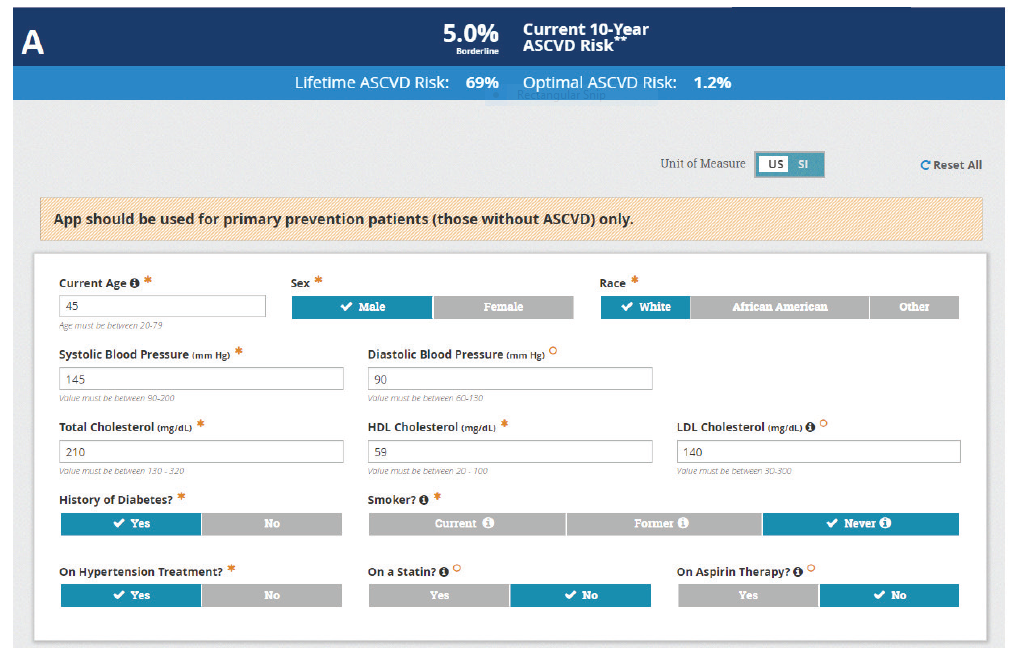
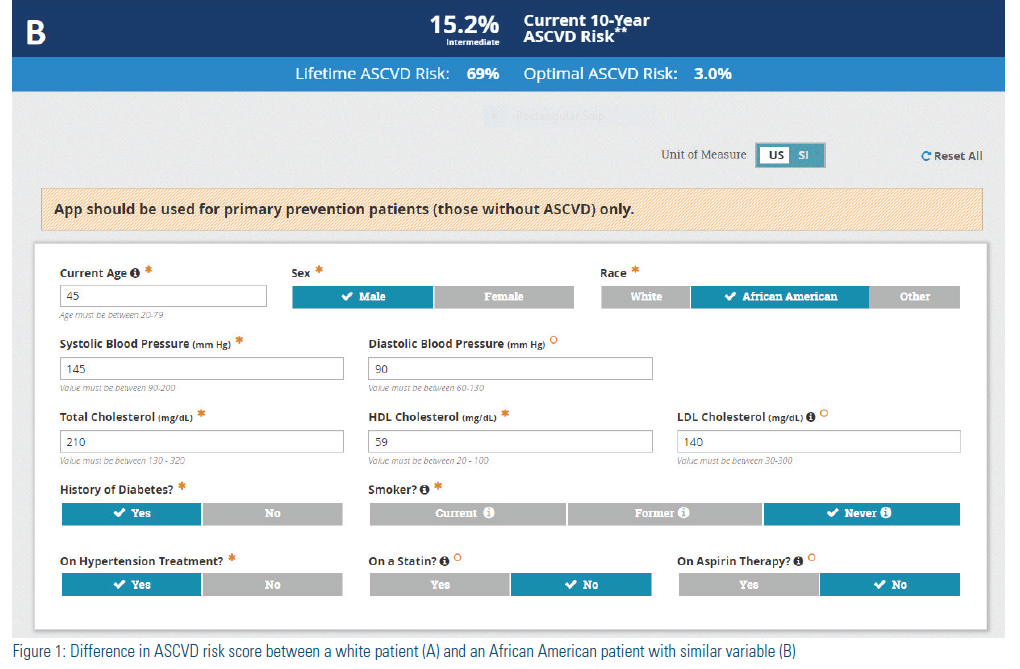
‘White’, ‘African American’, and ‘Other’. Importantly, it does note that certain ethnicities (such as South Asian) are considered high-risk and may affect the decision to initiate lipid therapy in patients with borderline or intermediate 10-year risk. Finally, the ‘resource’ section of the app discusses in detail how ASCVD risk varies by ethnicity (for instance, increased ASCVD risk is noted in African American women compared to White counterparts) and how the PCE may under- or overestimate risk in certain ethnicities.(1) Figure 1 shows how risk changes with race when other variables are the same.
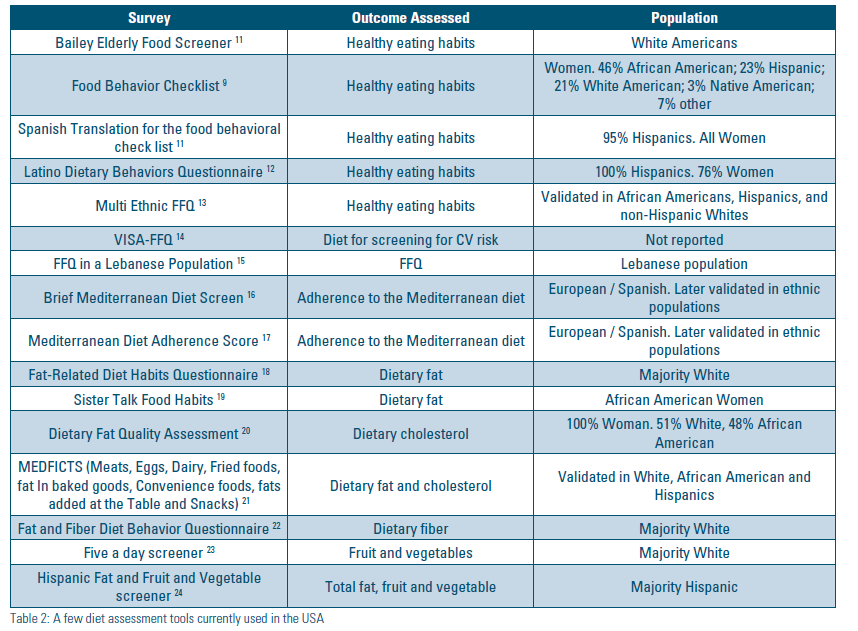
To expand on Table 1’s display of risk scores, the Framingham Risk Score (FRS)/adult treatment panel-111 (ATP-111), is one of the most commonly used algorithms for risk assessment, however it was validated in a white population lacking ethnic diversity.(2) The Systematic Coronary Risk evaluation (SCORE) algorithm, used in Europe, divides patients into high or low risk groups based on geographic location, including Eastern Europe and the Middle East.(3) The ASSIGN score, validated and used in Scotland, adds a social deprivation index, family history and smoking quantification to perform slightly better than the FRS in the index population.(4)
The QRISK1/2/3 scores were primarily developed for the British population. The QRISK2 scores added several important factors, including ethnicity. A major limitation is that it was validated on the same population it was derived from, the overwhelming majority of which was White. The QRISK 3 added various medical and psychiatric comorbidities, with ethnicity still included as in the QRISK 2.(5) The Reynolds Risk Score was initially developed for healthy women in the U.S. It was later validated on healthy men to predict 10-year risk of Myocardial Infarction (MI), stroke, or revascularization, and then again validated on female ethnic groups.(6)
Regardless of the choice of risk assessment tool used, they can be easily incorporated into clinical practice with the use of an online website, a smart phone app, or even integrated into the electronic health record where the score will appear if the variables are present within the patient’s chart. If the risk score does not incorporate race, it is important to consider separately the ways that race may influence risk, particularly where that risk may be modifiable.
Assessing risk of heart disease would not be complete without a thorough dietary assessment. Several surveys have been developed to assess healthy eating, adherence to the Mediterranean diet and fat/cholesterol consumption (table 2). Most questionnaires do not assess diet in a culturally specific fashion which may better correlate with one’s true diet. The Mediterranean Diet Score (MDS) was not originally validated in diverse populations, however, a high MDS score has been correlated with improved outcomes when applied to a study population of American Whites and Blacks as seen in the population-based, longitudinal cohort REGARDS (Reasons for Geographic and Racial Differences in Stroke) study of US residents.(8) Ethnic and race specific scores and questionnaires should be further studied since they may more accurately assess ASCVD risk across ethnic groups who are particularly at risk for cardiometabolic disease.
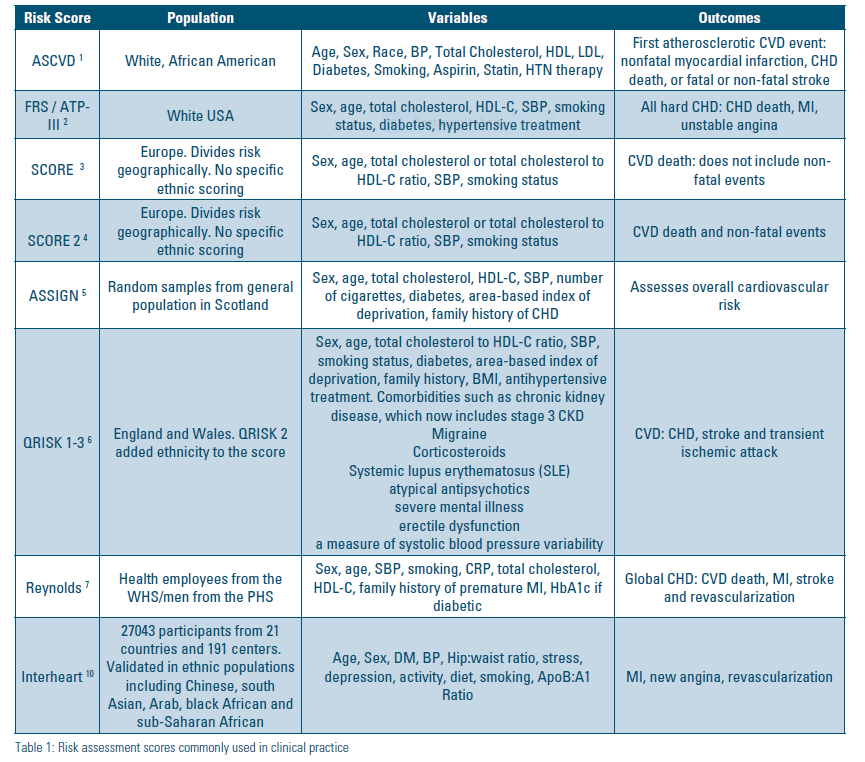
Other questionnaires that are tailored to ethnic and minority groups are available, but their prediction of cardiovascular outcomes has not been evaluated. The Food Behavior Checklist (FBC) was evaluated in a population of 46% African American, 23% Hispanic, and 21% White women.(8) The Sister Talk Food Habits and the Dietary Fat assessment had exclusively female responders (100%and 49% African American women, respectively). Three questionnaires are specifically tailored to the Hispanic population: Spanish translation of the FBC, the Latino Dietary Behaviors Questionnaire, and the Hispanic Fat and Fruit Screener.
Even without a culturally sensitive dietary assessment tool, a clinician can provide examples of foods specific to a patient’s culture to more accurately assess intake. Ideally, a partnership with a registered dietician or nutritionist can allow dedicated time for more open-ended recall techniques that may capture more culturally specific foods. Educational hand-outs such as those created by the NLA (page 48) can also be very useful guiding dietary change.
In summary, the various available risk scores for prediction of cardiovascular events have mostly been validated in white populations and populations that lack ethnic diversity. In addition, most questionnaires do not assess diet in a culturally specific fashion that may better correlate with one’s true diet. Ethnic and race specific scores and questionnaires should be further studied since they may more accurately assess ASCVD risk across ethnic groups who are particularly at risk for cardiometabolic disease.
Disclosure statement:
Dr. Eid has no financial disclosures to report.
Ms. Nahrwold has no financial disclosures to report.
Dr. Dunbar has no financial disclosures to report.
References:
1. Rana JS, Tabada GH, Solomon MD, et al. Accuracy of the Atherosclerotic Cardiovascular Risk Equation in a Large Contemporary, Multiethnic Population. J Am Coll Cardiol. 05 10 016;67(18):2118-2130. doi:10.1016/j.jacc.2016.02.055
2. D’Agostino RB, Vasan RS, Pencina MJ, et al. General cardiovascular risk profile for use in primary care: the Framingham Heart Study. Circulation. Feb 12 2008;117(6):743-53. doi:10.1161/CIRCULATIONAHA.107.699579
3. Conroy RM, Pyörälä K, Fitzgerald AP, et al. Estimation of ten-year risk of fatal cardiovascular disease in Europe: the SCORE project. Eur Heart J. Jun 2003;24(11):987-1003. doi:10.1016/s0195-668x(03)00114-3
4. collaboration SwgaECr. SCORE2 risk prediction algorithms: new models to estimate 10-year risk of cardiovascular disease in Europe. Eur Heart J. 07 01 2021;42(25):2439-2454. doi:10.1093/eurheartj/ehab309
5. Woodward M, Brindle P, Tunstall-Pedoe H, estimation Sgor. Adding social deprivation and family history to cardiovascular risk assessment: the ASSIGN score from the Scottish Heart Health Extended Cohort (SHHEC). Heart. Feb 2007;93(2):172-6. doi:10.1136/hrt.2006.108167
6. Hippisley-Cox J, Coupland C, Vinogradova Y, et al. Predicting cardiovascular risk in England and Wales: prospective derivation and validation of QRISK2. BMJ. Jun 28 2008;336(7659):1475-82. doi:10.1136/bmj.39609.449676.25
7. Ridker PM, Buring JE, Rifai N, Cook NR. Development and validation of improved algorithms for the assessment of global cardiovascular risk in women: the Reynolds Risk Score. JAMA. Feb 14 2007;297(6):611-9. doi:10.1001/jama.297.6.611
8. Shikany JM, Safford MM, Bryan J, et al. Dietary Patterns and Mediterranean Diet Score and Hazard of Recurrent Coronary Heart Disease Events and All-Cause Mortality in the REGARDS Study. J Am Heart Assoc. 07 12 2018;7(14)doi:10.1161/JAHA.117.008078
9. Townsend MS, Kaiser LL, Allen LH, Joy AB, Murphy SP. Selecting items for a food behavior checklist for a limited-resource audience. J Nutr Educ Behav. 2003 Mar-Apr 2003;35(2):69-77. doi:10.1016/s1499-4046(06)60043-2
10. McGorrian C, Yusuf S, Islam S, et al. Estimating modifiable coronary heart disease risk in multiple regions of the world: the INTERHEART Modifiable Risk Score. Eur Heart J. Mar 2011;32(5):581-9. doi:10.1093/eurheartj/ehq448
11. Bailey RL, Mitchell DC, Miller CK, et al. A dietary screening questionnaire identifies dietary patterns in older adults. J Nutr. Feb 2007;137(2):421-6. doi:10.1093/jn/137.2.421
12. Fernandez S, Olendzki B, Rosal MC. A dietary behaviors measure for use with low-income, Spanish-speaking Caribbean Latinos with type 2 diabetes: the Latino Dietary Behaviors Questionnaire. J Am Diet Assoc. Apr 2011;111(4):589-99. doi:10.1016/j.jada.2011.01.015
13. Mayer-Davis EJ, Vitolins MZ, Carmichael SL, et al. Validity and reproducibility of a food frequency interview in a Multi-Cultural Epidemiology Study. Ann Epidemiol. Jul 1999;9(5):314-24. doi:10.1016/s1047-2797(98)00070-2
14. Svendsen K, Henriksen HB, Østengen B, et al. Evaluation of a short Food Frequency Questionnaire to assess cardiovascular disease-related diet and lifestyle factors. Food Nutr Res. 2018;62doi:10.29219/fnr.v62.1370
15. Harmouche-Karaki M, Mahfouz M, Obeyd J, Salameh P, Mahfouz Y, Helou K. Development and validation of a quantitative food frequency questionnaire to assess dietary intake among Lebanese adults. Nutr J. 07 06 2020;19(1):65. doi:10.1186/s12937-020-00581-5
16. Schröder H, Fitó M, Estruch R, et al. A short screener is valid for assessing Mediterranean diet adherence among older Spanish men and women. J Nutr. Jun 2011;141(6):1140-5. doi:10.3945/jn.110.135566
17. Schröder H, Benitez Arciniega A, Soler C, et al. Validity of two short screeners for diet quality in time-limited settings. Public Health Nutr. Apr 2012;15(4):618-26. doi:10.1017/S1368980011001923
18. Spoon MP, Devereux PG, Benedict JA, et al. Usefulness of the food habits questionnaire in a worksite setting. J Nutr Educ Behav. 2002 Sep-Oct 2002;34(5):268-72. doi:10.1016/s1499-4046(06)60105-x
19. Anderson CA, Kumanyika SK, Shults J, Kallan MJ, Gans KM, Risica PM. Assessing change in dietary-fat behaviors in a weight-loss program for African Americans: a potential short method. J Am Diet Assoc. May 2007;107(5):838-42. doi:10.1016/j.jada.2007.02.014
20. Kraschnewski JL, Gold AD, Gizlice Z, et al. Development and evaluation of a brief questionnaire to assess dietary fat quality in low-income overweight women in the southern United States. J Nutr Educ Behav. 2013 Jul-Aug 2013;45(4):355-61. doi:10.1016/j. jneb.2012.10.008
21. Mochari H, Gao Q, Mosca L. Validation of the MEDFICTS dietary assessment questionnaire in a diverse population. J Am Diet Assoc.
22. Shannon J, Kristal AR, Curry SJ, Beresford SA. Application of a behavioral approach to measuring dietary change: the fat- and fiber-related diet behavior questionnaire. Cancer Epidemiol Biomarkers Prev. May 1997;6(5):355-61.
23. Thompson FE, Kipnis V, Subar AF, et al. Evaluation of 2 brief instruments and a food-frequency questionnaire to estimate daily number of servings of fruit and vegetables. Am J Clin Nutr. Jun 2000;71(6):1503-10. doi:10.1093/ajcn/71.6.1503
24. Wakimoto P, Block G, Mandel S, Medina N. Development and reliability of brief dietary assessment tools for Hispanics. Prev Chronic Dis. Jul 2006;3(3):A95.