

Sodium-glucose co-transporter 2 inhibitors (SGLT2i) are novel, effective oral anti-hyperglycemic medications that inhibit glucose reabsorption in the proximal convoluted tubule of the kidney, independent of insulin, leading to glucosuria and glucose-lowering effects.1 Studies revealed that SGLT2i reduces cardiovascular (CV) morbidity and mortality, especially in high-risk patients with type 2 diabetes mellitus (T2DM).2,3 The consistent CV benefits with the class of SGLT2i were a reduction in risk of heart failure and kidney outcomes.4-9 Four SGLT2i are available for clinical use in the United States. Canagliflozin is approved for use in patients with T2DM with or without cardiovascular disease (CVD).10 Empagliflozin and Dapagliflozin have an additional indication to reduce the risk of CV death and hospitalization for heart failure in adults with heart failure and reduced ejection fraction.11,12 Ertugliflozin is approved for use in patients with T2DM to improve glycemic control only.13 Studies with SGLT2i also demonstrated improvement in other CV risk factors such as blood pressure reduction and weight loss.14 These favorable findings promote the use of SGLT2i to treat high-risk patients with T2DM. While using SGLT2i is generally safe15, their impact on lipid profile which is an important CVD risk factor is unclear. This understanding is especially important as T2DM, which is a common indication for SGLT2i use, is associated with dyslipidemia characterized by high triglycerides, low HDL-C, high LDL-C with a predominance of atherogenic small, dense LDL particles.16 This article presents the available literature on the effects of SGLT2i on lipid profile.
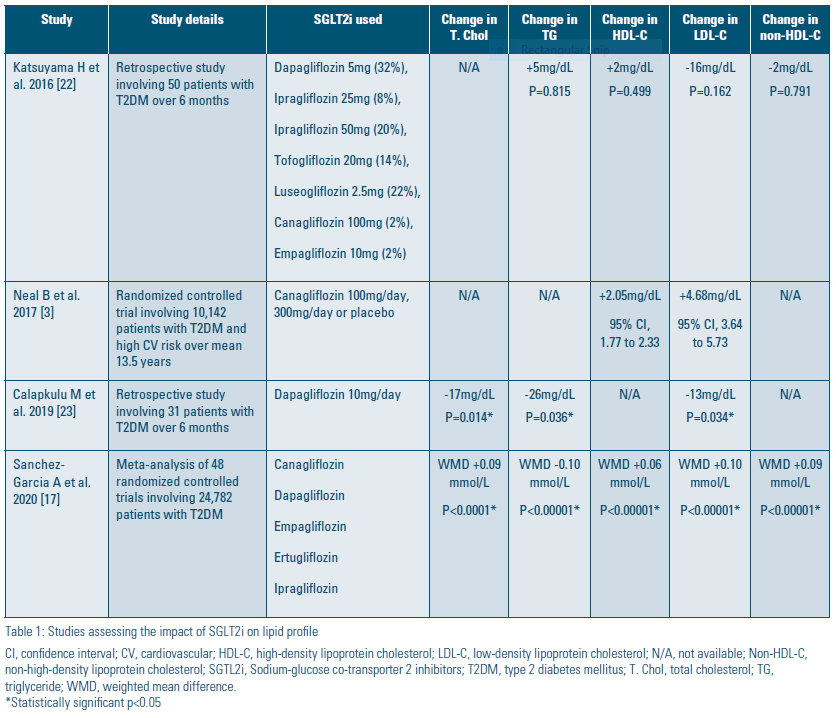
Studies have reported inconsistent findings on the impact of SGLT2i on lipid profile, as shown in Table 1. In the meta-analysis of 48 randomized controlled trials17 by Sanchez-Garcia A et al., Dapagliflozin (weighted mean difference or WMD -0.13 mmol/L) and Canagliflozin (WMD -0.12 mmol/L) showed a significant reduction in triglycerides, but not Empagliflozin (WMD -0.04 mmol/L, p=0.05). Canagliflozin showed the largest effect in increasing LDL-C (0.13 mmol/L), while Empagliflozin had the highest increase in total cholesterol (0.11 mmol/L). Canagliflozin, Dapagliflozin, and Empagliflozin resulted in a significant increase in HDL-C 17. Limitations of this meta-analysis include interpretations derived from secondary outcomes, high variability between studies, and no CV outcome trials. Most large CV outcome trials on SGLT2i did not provide lipid data. Zinman B et al. found that Empagliflozin reduced composite CV outcomes (HR 0.86, 95% CI, 0.74 to 0.99, p=0.04 for superiority), and showed small increases in both LDL-C and HDL-C (specific data unknown) compared to placebo, with no between-group difference in the receipt of lipid-lowering drugs.2 Neal B et al. found that Canagliflozin showed a lower risk of CV events (HR 0.86, 95% CI, 0.75 to 0.97, p=0.02 for superiority), but, there was an increase in LDL-C (+4.68 mg/dL, 95% CI, 3.64 to 5.73) and HDL-C (+2.05 mg/dL, 95% CI, 1.77 to 2.33) compared to placebo, with no between-group difference in the receipt of lipid-lowering drugs.3
The mechanisms of SGLT2i associated lipid changes are largely unknown; however, some theories have been proposed. The increase in HDL-C and decrease in triglycerides with SGLT2i might be due to improvement in insulin secretion and sensitivity, which reduces hepatic synthesis and increases catabolism of triglyceride-rich particles.18 The increase in LDL-C is likely due to hemoconcentration from natriuresis and calorie loss in urine mimicking starvation shifting energy from carbohydrate to lipid utilization.19 This shift leads to ketogenesis, increased intracellular cholesterol production, and decreased LDL receptor expression, which increases plasma LDL-C levels. SGLT2i also decreases the concentration of atherogenic small, dense LDL particles and increases favorable large, buoyant LDL particles.20 The pharmacokinetic differences between SGLT2i, such as high SGLT2 selectivity with Empagliflozin followed by Ertugliflozin, Dapagliflozin, and Canagliflozin, might be a contributing factor to variable lipid effects.21 Typically, an increase in LDL-C is directly proportional to CVD risk.24 Therefore, favorable CV outcomes with SGLT2i despite an increase in LDL-C are surprising. Factors likely contributing to these findings with SGLT2i include an increase in HDL-C, decrease in triglycerides, favorable changes in LDL particles reducing residual CVD risk, especially in patients with diabetic dyslipidemia. SGLT2i are also associated with other anti-atherogenic mechanisms such as improved blood pressure, weight loss, decreased endothelial dysfunction, decrease in inflammation, LDL- and macrophage-derived fecal cholesterol excretion.14,19 However, more data is needed to make meaningful conclusions on the impact of SGLT2i associated lipid changes on CVD risk.
Overall, the SGLT2i class demonstrates a mild increase in HDL-C levels. While the potential for an increase in LDL-C and triglyceride with SGLT2i use can raise a concern about their CV safety, minimal changes in these atherogenic lipoproteins and reassuring effect of SGLT2i class on reducing the risk of heart failure suggests less clinical relevance of these changes. Although there is some data, there is a significant literature gap in SGLT2i lipid effects prompting a need for more research on these concepts, especially on the effects of SGLT2i on long-term lipid and CV outcomes.
Disclosure statement: Dr. Pulipati has no financial disclosures to report.
References
- Hsia DS, Grove O, Cefalu WT. An update on sodium-glucose co-transporter-2 inhibitors for the treatment of diabetes mellitus. Curr Opin Endocrinol Diabetes Obes. 2017;24(1):73-79. doi:10.1097/MED.0000000000000311
- Zinman B, Wanner C, Lachin JM, et al. Empagliflozin, Cardiovascular Outcomes, and Mortality in Type 2 Diabetes. N Engl J Med. 2015;373(22):2117-2128. doi:10.1056/NEJMoa1504720
- Neal B, Perkovic V, Matthews DR. Canagliflozin and Cardiovascular and Renal Events in Type 2 Diabetes. N Engl J Med. 2017;377(21):2099. doi:10.1056/NEJMc1712572
- McMurray JJV, Solomon SD, Inzucchi SE, et al. Dapagliflozin in Patients with Heart Failure and Reduced Ejection Fraction. N Engl J Med. 2019;381(21):1995-2008. doi:10.1056/NEJMoa1911303
- Packer M, Anker SD, Butler J, et al. Cardiovascular and Renal Outcomes with Empagliflozin in Heart Failure. N Engl J Med. 2020;383(15):1413-1424. doi:10.1056/NEJMoa2022190
- Anker SD, Butler J, Filippatos G, et al. Empagliflozin in Heart Failure with a Preserved Ejection Fraction. N Engl J Med. 2021;385(16):1451-1461. doi:10.1056/NEJMoa2107038
- Perkovic V, Jardine MJ, Neal B, et al. Canagliflozin and Renal Outcomes in Type 2 Diabetes and Nephropathy. N Engl J Med. 2019;380(24):2295-2306. doi:10.1056/NEJMoa1811744
- Heerspink HJL, Stefánsson BV, Correa-Rotter R, et al. Dapagliflozin in Patients with Chronic Kidney Disease. N Engl J Med. 2020;383(15):1436-1446. doi:10.1056/NEJMoa2024816
- McGuire DK, Shih WJ, Cosentino F, et al. Association of SGLT2 Inhibitors With Cardiovascular and Kidney Outcomes in Patients With Type 2 Diabetes: A Meta-analysis. JAMA Cardiol. 2021;6(2):148-158. doi:10.1001/jamacardio.2020.4511
- Prescribing information for Canagliflozin. https://www.accessdata. fda.gov/drugsatfda_docs/label/2018/204042s027lbl.pdf
- Prescribing information for Empagliflozin. https://www.accessdata. fda.gov/drugsatfda_docs/label/2021/204629s026lbl.pdf
- Prescribing information for Dapagliflozin. https://www.accessdata. fda.gov/drugsatfda_docs/label/2020/202293s020lbl.pdf
- Prescribing information for Ertugliflozin. https://www.accessdata. fda.gov/drugsatfda_docs/label/2021/209803s004lbl.pdf
- Szekeres Z, Toth K, Szabados E. The Effects of SGLT2 Inhibitors on Lipid Metabolism. Metabolites. 2021;11(2):87. Published 2021 Feb 1. doi:10.3390/metabo11020087
- Lin DS, Lee JK, Chen WJ. Clinical Adverse Events Associated with Sodium-Glucose Cotransporter 2 Inhibitors: A Meta-Analysis Involving 10 Randomized Clinical Trials and 71 553 Individuals. J Clin Endocrinol Metab. 2021;106(7):2133-2145. doi:10.1210/clinem/dgab274
- Wu L, Parhofer KG. Diabetic dyslipidemia. Metabolism. 2014;63(12):1469-1479. doi:10.1016/j.metabol.2014.08.010
- Sánchez-García A, Simental-Mendía M, Millán-Alanís JM, Simental-Mendía LE. Effect of sodium-glucose co-transporter 2 inhibitors on lipid profile: A systematic review and meta-analysis of 48 randomized controlled trials. Pharmacol Res. 2020;160:105068. doi:10.1016/j.phrs.2020.105068
- Kern M, Klöting N, Mark M, Mayoux E, Klein T, Blüher M. The SGLT2 inhibitor empagliflozin improves insulin sensitivity in db/db mice both as monotherapy and in combination with linagliptin. Metabolism. 2016;65(2):114-123. doi:10.1016/j. metabol.2015.10.010
- Briand F, Mayoux E, Brousseau E, et al. Empagliflozin, via Switching Metabolism Toward Lipid Utilization, Moderately Increases LDL Cholesterol Levels Through Reduced LDL Catabolism. Diabetes. 2016;65(7):2032-2038. doi:10.2337/db16-0049
- Hayashi T, Fukui T, Nakanishi N, et al. Dapagliflozin decreases small dense low-density lipoprotein-cholesterol and increases high-density lipoprotein 2-cholesterol in patients with type 2 diabetes: comparison with sitagliptin [published correction appears in Cardiovasc Diabetol. 2017 Nov 13;16(1):149]. Cardiovasc Diabetol. 2017;16(1):8. Published 2017 Jan 13. doi:10.1186/s12933-016-0491-5
- Cinti F, Moffa S, Impronta F, et al. Spotlight on ertugliflozin and its potential in the treatment of type 2 diabetes: evidence to date. Drug Des Devel Ther. 2017;11:2905 2919. Published 2017 Oct 3. doi:10.2147/DDDT.S114932
- Katsuyama H, Hamasaki H, Adachi H, et al. Effects of Sodium-Glucose Cotransporter 2 Inhibitors on Metabolic Parameters in Patients With Type 2 Diabetes: A Chart-Based Analysis. J Clin Med Res. 2016;8(3):237-243. doi:10.14740/jocmr2467w
- Calapkulu M, Cander S, Gul OO, Ersoy C. Lipid profile in type 2 diabetic patients with new dapagliflozin treatment; actual clinical experience data of six months retrospective lipid profile from single center. Diabetes Metab Syndr. 2019;13(2):1031-1034. doi:10.1016/j.dsx.2019.01.016
- Grundy SM, Stone NJ, Bailey AL, et al. 2018 AHA/ACC/AACVPR/AAPA/ABC/ACPM/ADA/AGS/APhA/ASPC/NLA/PCNA Guideline on the Management of Blood Cholesterol: Executive Summary: A Report of the American College of Cardiology/American Heart Association Task Force on Clinical Practice Guidelines [published correction appears in J Am Coll Cardiol. 2019 Jun 25;73(24):3234-3237]. J Am Coll Cardiol. 2019;73(24):3168-3209. doi:10.1016/j. jacc.2018.11.002