

Atherosclerosis occurs due to a complex interaction between dyslipidemia and proinflammatory molecules.(1) It is the key culprit for globally prevalent cardiovascular diseases (CVD). Vascular inflammation may lead to atherosclerotic plaque rupture, thrombus formation, and subsequent occlusion, causing ischemia and infarction.(2) Residual CVD risk in statin-treated adults has prompted the examination of other risk factors, including inflammation.(3) High-sensitivity C-reactive protein (hs-CRP) is the most widely used biomarker of inflammation. Elevated baseline and longitudinal hs-CRP levels after acute coronary syndrome (ACS) are associated with a greater risk of adverse cardiovascular (CV) outcomes despite lipid-lowering therapy.(4) In the CANTOS (Canakinumab Antiinflammatory
Thrombosis Outcome Study) trial involving patients with previous myocardial infarction (MI) and hs-CRP >2 mg/L, canakinumab (a monoclonal antibody targeting interleukin-1β [IL-1β]; 150 mg every 3 months) led to a significantly lower rate of recurrent CV events independent of lipid-lowering (hazard ratio [HR]:0.85, 95% confidence interval [CI], 0.74 to 0.98; p=0.021).(5) These findings stimulated interest in evaluating the efficacy of other anti-inflammatory medications – such as colchicine – on CVD risk reduction. Randomized controlled trials assessing colchicine revealed contradictory CV effects challenging the clinical applicability of this therapy. Careful examination and comparison of these trials show significant differences in study design, likely contributing to observed divergent results. Herein, we review published and ongoing trials assessing colchicine’s impact on secondary CVD prevention.
Introduction to colchicine as a CV therapy
Colchicine is an oral anti-inflammatory medication that interferes with neutrophil function and activation of IL-1β.(6) The United States Food and Drug Administration-approved indications for colchicine use include familial Mediterranean fever as well as prophylaxis and treatment of gout flares.(6) The most common adverse reaction is diarrhea. The convergence of evidence from randomized controlled trials assessing colchicine efficacy suggests a reduction in composite CV adverse outcomes in a range of patients with established CVD (7) In the LoDoCo (Low Dose Colchicine) trial (Table 1) involving patients with clinically stable coronary disease, colchicine was associated with significantly lower CV events compared to no treatment (HR:0.33; 95% CI 0.18 to 0.59; p <0.001).(8) This study was not placebo-controlled, and the results almost entirely represent non-fatal CV events. Among diabetic patients undergoing percutaneous coronary intervention with a bare-metal stent, colchicine use showed a decrease in in-stent restenosis.(9) In the LoDoCo-MI (Low Dose Colchicine after Myocardial Infarction) trial assessing the proportion of patients with a high residual hs-CRP >2 mg/L after 30 days of therapy, low-dose colchicine was not associated with an increased likelihood of achieving hs-CRP <2 mg/L at 30 days after acute MI (p=0.35).(10) However, this study was done at a single-center for a short duration of 30 days and was not sufficiently powered to show the effect of colchicine on CVD events. However, it demonstrated the safety and tolerability of low-dose colchicine after acute MI.
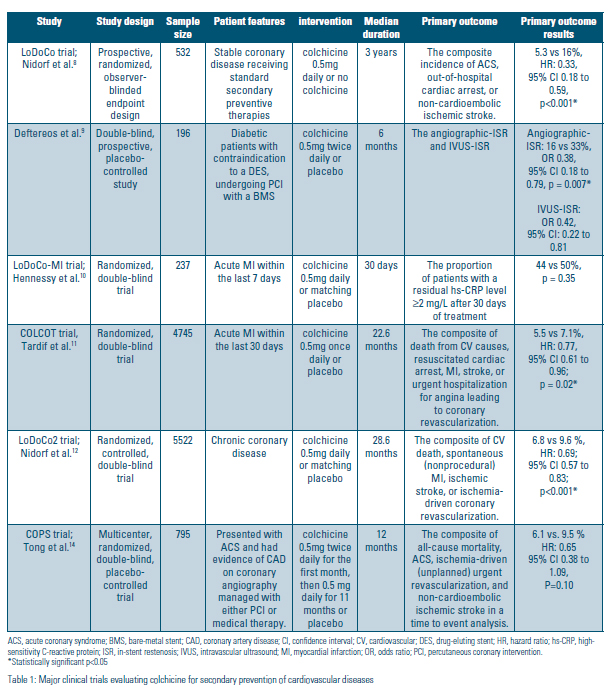
Recent trials assessing the effect of colchicine on secondary CVD prevention
The COLCOT (COLchicine Cardiovascular Outcomes Trial) recruited 4745 patients within 30 days after MI and randomized them to receive low-dose colchicine or placebo for a median of 22.6 months.(11) The colchicine group showed significantly lower risk of ischemic CV events (HR:0.77, 95% CI 0.61 to 0.96; p=0.02). The results were predominantly driven by the lesser occurrence of stroke (HR:0.26; 95% CI, 0.10 to 0.70) and urgent hospitalizations for angina leading to coronary revascularization (HR:0.50; 95% CI, 0.31 to 0.81). In COLCOT, placebo-adjusted geometric mean percent change in hs-CRP was -10.1% in colchicine group (95% CI, -28.6 to 13.4); hs-CRP was measured only in a small subgroup of 207 patients at the time of randomization and after 6 months, limiting its interpretation. In the LoDoCo2 (second Low Dose Colchicine) involving 5522 participants, colchicine showed a significantly lower risk of CV events compared to placebo among patients with chronic coronary disease (HR:0.69, 95% CI 0.57 to 0.83; p<0.001).(12) A sub-study of LoDoCo2 targeting proteomic analysis on patient serum samples before and after 30 days of colchicine treatment revealed a decrease in inflammatory markers.(13)
In the COPS (COlchicine in Patients with acute coronary Syndromes) trial, the addition of colchicine to standard medical therapy in patients hospitalized with ACS did not significantly affect CV outcomes at 12 months (HR:0.65, 95% CI, 0.38 to 1.09, p=0.10).(14) In this study, colchicine was associated with a higher rate of total death (p=0.017), especially non-CV death (p=0.024). Post-hoc analyses, including 400-day follow-up and only CV death, demonstrated a significant reduction in the primary outcome in favor of colchicine. COPS had multiple limitations, including failure to reach the target study number, possibly due to the lack of remuneration for patient recruitment, which may have led to low power to demonstrate colchicine benefits. A higher-than expected event rate was likely due to minimal restrictions on inclusion criteria, resulting in the recruitment of a high-risk population. Also, the number of patients lost to follow-up logistics was similar to the number of deaths, thereby limiting interpretation of mortality data.
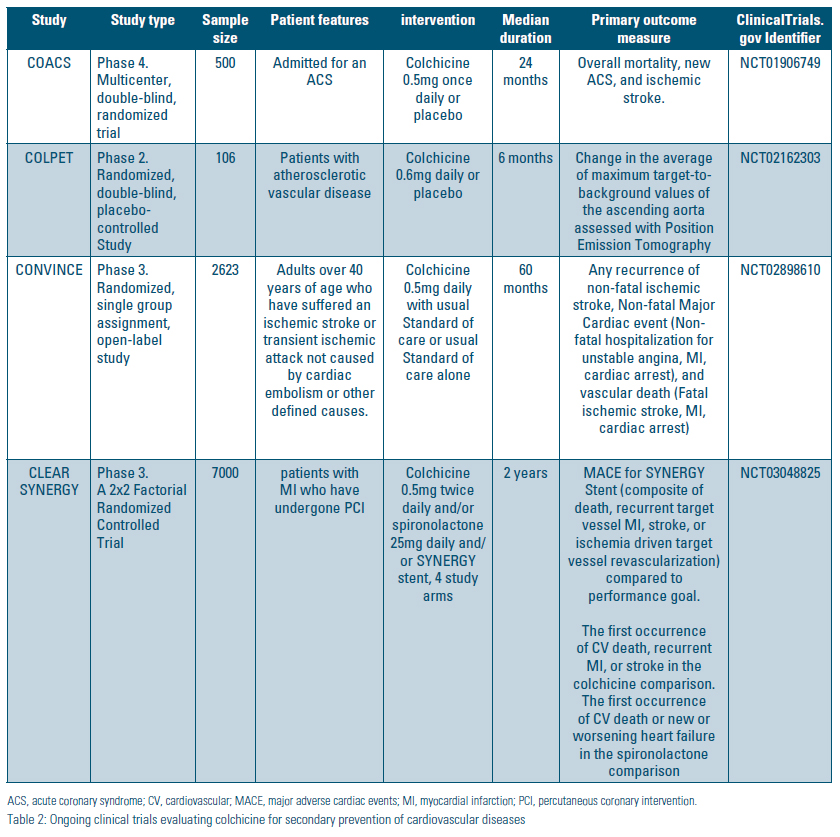
Future trials assessing the effect of colchicine on secondary CVD prevention
Ongoing clinical trials investigating the effects of colchicine on secondary CVD prevention include the COACS (Colchicine for Acute Coronary Syndromes) (NCT01906749), COLPET (Colchicine in Vascular Inflammation Assessed with PET Imaging) (NCT02162303), CONVINCE (Colchicine for Prevention of Vascular Inflammation in Non-cardioEmbolic Stroke) (NCT02898610), and CLEAR-SYNERGY (Colchicine and Spironolactone in Patients with MI/ SYNERGY Stent Registry) (NCT03048825) (Table 2). These are all randomized clinical trials, but COACS, CONVINCE, and CLEAR SYNERGY are CV outcome trials. CLEAR SYNERGY is the largest ongoing trial that will be performed over two years in patients with MI. This study contains four arms (colchicine 0.5
mg twice daily and/or spironolactone 25 mg daily and/or SYNERGY stent and/or colchicine/spironolactone-placebo) that represent the best approach to demonstrating colchicine’s utility in secondary CVD prevention.
Perspectives
Among the studies presented above, COLCOT, LoDoCo2, and COPS were randomized, double-blind, placebocontrolled CV outcome trials assessing colchicine use for secondary CVD prevention. The COLCOT was an international study, but LoDoCo2 (Australia, Netherlands) and COPS (Australia) were geographically limited. LoDoCo2 included the lowest percentage of women (15.3%) compared to COLCOT (19.2%) and COPS (21%). The underrepresentation of women – given a higher percentage of women with chronic coronary disease in the general population – might prompt caution in the broad interpretation of the data relating to women. COPS patients presented with ACS, while COLCOT and LoDoCo2 patients had established CVD. The impact
of acuity of illness on the efficacy of lowdose colchicine is unclear.
Conclusion
Herein we have summarized the similarities and differences between the study design of conflicting trials assessing the efficacy of colchicine for secondary CVD prevention. Among the recent trials, LoDoCo2, followed by COLCOT, had the largest sample number and longest duration with fewer limitations, making them the most useful for drawing meaningful conclusions. Both of these trials revealed significantly lower recurrent CV events with low-dose colchicine. In this era of personalized medicine it will
be interesting to see if ongoing studies of secondary CVD risk reduction with colchicine support earlier positive data. If long-term prospective trials continue to show favorable results, the use of widely available, inexpensive colchicine might have an enormous impact on residual inflammatory risk and secondary CVD prevention.
Disclosure statement:
Dr. Pulipati has no financial disclosures to report. Dr. Koschinsky has received honoraria from Novartis Canada, Ayma Therapeutics, Noetic Insights, Abcentra Therapeutics, and Osborne Clark (UK).
References:
- Manduteanu I, Simionescu M. Inflammation in atherosclerosis: a cause or a result of vascular disorders?. J Cell Mol Med. 2012;16(9):1978-1990.
- Hansson GK, Robertson AK, Söderberg-Nauclér C. Inflammation and atherosclerosis. Annu Rev Pathol. 2006;1:297-329.
- Wong ND, Zhao Y, Quek RGW, et al. Residual atherosclerotic cardiovascular disease risk in statin-treated adults: The Multi-Ethnic Study of Atherosclerosis. J Clin Lipidol. 2017;11(5):1223-1233.
- Mani P, Puri R, Schwartz GG, et al. Association of Initial and Serial C-Reactive Protein Levels With Adverse Cardiovascular Events and Death After Acute Coronary Syndrome: A Secondary Analysis of the VISTA-16 Trial. JAMA Cardiol. 2019;4(4):314-320.
- Ridker PM, Everett BM, Thuren T, et al. Anti-inflammatory Therapy with Canakinumab for Atherosclerotic Disease. N Engl J Med. 2017;377(12):1119-1131.
- https://www.accessdata.fda.gov/drugsatfda_docs/label/2014/022352s017lbl.pdf
- Verma S, Eikelboom JW, Nidorf SM, et al. Colchicine in cardiac disease: a systematic review and meta-analysis of randomized controlled trials. BMC Cardiovasc Disord. 2015;15:96. Published 2015 Aug 29.
- Nidorf SM, Eikelboom JW, Budgeon CA, Thompson PL. Low-dose colchicine for secondary prevention of cardiovascular disease. J Am Coll Cardiol. 2013;61(4):404-410.
- Deftereos S, Giannopoulos G, Raisakis K, et al. Colchicine treatment for the prevention of bare-metal stent restenosis in diabetic patients. J Am Coll Cardiol. 2013;61(16):1679-1685.
- Hennessy T, Soh L, Bowman M, et al. The Low Dose Colchicine after Myocardial Infarction (LoDoCo-MI) study: A pilot randomized placebo controlled trial of colchicine following acute myocardial infarction. Am Heart J. 2019;215:62-69.
- Tardif JC, Kouz S, Waters DD, et al. Efficacy and Safety of Low-Dose Colchicine after Myocardial Infarction. N Engl J Med. 2019;381(26):2497-2505.
- Nidorf SM, Fiolet ATL, Mosterd A, et al. Colchicine in Patients with Chronic Coronary Disease. N Engl J Med. 2020;383(19):1838-1847.
- Opstal TSJ, Hoogeveen RM, Fiolet ATL, et al. Colchicine Attenuates Inflammation Beyond the Inflammasome in Chronic Coronary Artery Disease: A LoDoCo2 Proteomic Substudy. Circulation 2020 Nov 17;142(20):1996-1998.
- Tong DC, Quinn S, Nasis A, et al. Colchicine in Patients With Acute Coronary Syndrome: The Australian COPS Randomized Clinical Trial. Circulation. 2020;142(20):1890-1900.