

A greater prevalence of dyslipidemia, insulin resistance, and atherosclerotic cardiovascular disease (ASCVD) and related-mortality are now well-recognized in South Asians living in the U.S. (SAUS), a fast-growing group that includes individuals from India, Pakistan, Bangladesh, Sri Lanka, Nepal, Maldives, and Bhutan. In light of their elevated ASCVD risk, SA ancestry was recognized as a “risk enhancing factor” in the 2018 ACC/AHA/Multisociety Cholesterol Management Guideline.(1) A recently published NLA Clinical Perspective by Kalra et al. from the NLA SA Work Group (SAWG) (2) has provided new insight into the epidemiology and mechanisms of ASCVD risk in SAUS, as well as screening, treatment, and population management strategies.
The 20-page NLA document highlights the multifactorial etiology of elevated ASCVD risk in SAUS, including a higher prevalence of atherogenic dyslipidemia, elevated lipoprotein(a) (LPa) and inflammatory markers, insulin resistance, metabolic syndrome, diabetes, non-alcoholic fatty liver disease (NAFLD), and pro-atherogenic dietary, lifestyle, and psychosocial factors. The article outlines key findings from observational studies, including the Mediators of Atherosclerosis in South Asians Living in America (MASALA) study. A prospective cohort of >900 SAUS living in San Francisco and Chicago, MASALA has shown that SAUS have a higher prevalence of pre-diabetes (33%) and diabetes mellitus (25%),(3) which can occur in SA’s up to a decade earlier and in association with a lower BMI.(4) Not surprisingly, atherogenic dyslipidemia is also more common, including significantly lower levels of HDL-cholesterol, higher triglyceride (TG) levels, and increased numbers of small, dense LDL particles.(5)
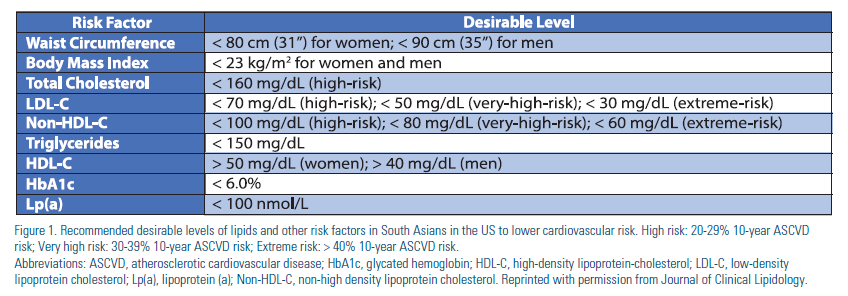
Findings from the MASALA study suggest that diet may also contribute to ASCVD risk in SAUS, who have been shown to consume more animal protein, fried foods, sweets, refined carbohydrates and saturated fat, and fewer fruits and vegetables.(3) Psychosocial factors and acculturation may underlie some of these differences. A longer duration of residence in the US has been associated with a higher intake of saturated and trans fats and greater amounts of subclinical atherosclerosis in SAUS.(6) Finally and importantly, genetic factors clearly contribute to ASCVD risk in SAUS. SA’s have been found to have differences in body composition (a higher degree of visceral fat and less lean body mass),(3) which are believed to have genetic and evolutionary origins. A single nucleotide polymorphism (SNP) that increases susceptibility to NAFLD also has been found, which, in turn, predisposes to changes in insulin sensitivity.(7) Based on their proatherogenic risk profiles, different thresholds for desirable levels of ASCVD risk factors are recommended by the NLA-SAWG and others (Figure 1), including a BMI <23 kg/m2, total cholesterol <160 mg/dl, LDL-C <70mg/dL, Non-HDL-C <100 mg/dl, HbA1c <6% and Lp(a) <100 nmol/L, with more stringent LDL-C thresholds recommended in those with established ASCVD, as discussed below.(2,8)
The NLA-SAWG also tackles the difficult problem of global ASCVD risk assessment in SAUS, which is underestimated by the ACC/AHA pooled cohort equation and Framingham risk score. The authors note that the European QRISK3 score, which includes traditional risk factors, family history, socioeconomic factors, and co-morbid conditions, has been validated in SA’s living in the UK and may be appropriate for SAUS.(9) In addition, the authors note that coronary artery calcification (CAC) scores have been found to have strong predictive value in SAUS, who have been found to have a higher burden of CAC compared to age-matched groups.(10) CAC scoring is thus recommended as the preferred non-invasive modality for reclassifying risk in SAUS. The overall approach recommended by the NLA-SAWG is to individualize risk assessment and consider CAC scoring in those over age 35 years, especially when the family history includes premature ASCVD.
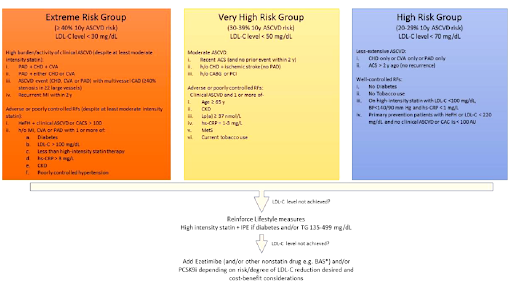
Tailored treatment of ASCVD risk in SAUS is also emphasized. In addition to conventional lifestyle interventions, the authors recommend culturally tailored approaches, including diets higher in whole grains and lean proteins and lower in unhealthy fats and tropical oils, and exercise and stress management through Bollywood-style dancing, and yoga. Pharmacologic lipid lowering agents for SAUS do not differ from current guideline-directed therapies, and include statins, ezetimibe, and PCSK9 inhibitors, the latter for patients at high ASCVD risk. Importantly, the NLA-SAWG, in alignment with the Lipid Association of India, has recommended lower LDL-C treatment thresholds in SAUS with very high ASCVD risk (>30% or more) based on the definitions outlined in Figure 2.(2) They note that icosapent ethyl may become useful for targeting residual hypertriglyceridemia in high risk SAUS.
Finally, the NLA-SAWG emphasizes the need for a multi-pronged population management approach to reduce ASCVD risk in SAUS. Ideally, SAUS should be educated about their increased risk of ASCVD during school and at social and religious gatherings, and be empowered early to pursue healthy lifestyles and regular screening. Within health systems, data mining of Electronic Health Records, E.H.Rs can help identify care gaps in SAUS that can be closed via mailings, specialized prevention clinics, and community outreach programs, the latter which can be extended to mosques, temples and sports venues. The authors recommend that clinicians be educated about how to recognize and treat ASCVD risk in SAUS, and to overcome social and cultural barriers to risk reduction, including via team care by dietitians and pharmacists. Professional societies can develop educational content for dissemination through websites and social media. Finally, the authors recommend that federal policies be developed that target ASCVD risk in SAUS, and cite HR 3131, the South Asian Heart Health Awareness and Research Act passed by the House in 2020. In summary, this expert NLA Clinical Perspective offers up-to-date, practice-changing information pertinent to providers, payers, and policy makers focused on improving cardiovascular health in South Asians.
Disclosure statement:
Dr. T. Imran has no financial disclosures to report.
Dr. H. Imran has no financial disclosures to report.
Dr. Aspry has received honoraria from Amgen, Esperion, Novartis, and Ionis.
References:
1. Grundy SM , Stone NJ , Bailey AL , et al. AHA/ACC/AACVPR/AAPA/ ABC/ACPM/ADA/AGS/APhA/ASPC/NLA/PCNA guideline on the management of blood cholesterol: a report of the American College of Cardiology/American Heart Association task force on clinical practice guidelines. J Am Coll Cardiol . 2018;73:e285–e350.
2. Kalra D, Vijayaraghavan K, Sikand G, et al. Prevention of Atherosclerotic Cardiovascular Disease in South Asians in the US: A clinical perspective from the National Lipid Association. Journal of Clinical Lipidology. 2021;15, 402–422.
3. Shah AD , Vittinghoff E , Kandula NR , Srivastava S , Kanaya AM . Correlates of prediabetes and type II diabetes in US South Asians: findings from the mediators of atherosclerosis in South Asians living in Amer ica (MASALA) study. Ann Epidemiol . 2015;25:77–83.
4. Iyengar SS , Puri R , Narasingan SN , et al. Lipid association of India expert consensus statement on management of dyslipidemia in Indians 2016: part 1. J Assoc Physicians India . 2016;64:7–52.
5. Kulkarni KR , Markovitz JH , Nanda NC , Segrest JP . Increased prevalence of smaller and denser LDL particles in Asian Indians. Arte- rioscler Thromb Vasc Biol . 1999;19:2749–2755.
6. Talegawkar SA , Kandula NR , Gadgil MD , Desai D , Kanaya AM. Dietary intakes among South Asian adults differ by length of residence in the USA. Public Health Nutr . 2016;19:348–355.
7. Vijayaraghavan K , Brown A. South Asian ancestry as a risk enhancer for ASCVD: merits and challenges. J Clin Lipidol . 2019;13:522–524
8. Consultation WHO Appropriate body-mass index for Asian populations and its implications for policy and intervention strategies. Lancet . 2004;363:157–163.
9. Hippisley-Cox J, Coupland C, Brindle P. Development and validation of QRISK3 risk prediction algorithms to estimate future risk of cardiovascular disease: A prospective cohort study. BMJ 2017;357:j2099.
10. Kanaya AM , Kandula NR , Ewing SK , et al. Comparing coronary artery calcium among U.S. South Asians with four racial/ethnic groups: the MASALA and MESA studies. Atherosclerosis 2014;234:102–107.