

Structure, Function, Dietary Sources
Trans fatty acids (TFAs) are industrially produced during the partial hydrogenation of vegetable oils and they contain at least one double bond in the trans configuration. Smaller amounts are found naturally in meat and dairy products as a result of bacterial fermentation in ruminant animals.1 Partial hydrogenation of vegetable oil increases its stability for commercial deep-frying, prolongs product shelf life, and improves the mouth feel, palatability, and texture for many fried and baked foods.2,3 Increased risk of cardiovascular disease (CVD) associated with the dietary consumption of trans fatty acids has been well publicized,2 leading many individuals to switch back to using butter.
Partially hydrogenated oils (PHOs) became more widely used during World War II, when butter was rationed and people began using margarine and shortening as inexpensive substitutes.4 Their use increased during the 1980s, as evidence accumulated showing an association between saturated fat — the predominant fat in butter — and increased cholesterol levels, and food manufacturers sought to find healthier alternatives. In the following decade, studies began to demonstrate a negative relationship between TFAs and coronary heart disease (CHD).3,4
Evidence Regarding Health Implications
A growing body of research has provided substantial evidence that consumption of industrially produced TFAs is associated with increased CHD risk and adverse changes in several cardiometabolic markers. Although the negative effects of TFAs tend to be most prominent when TFAs are compared to cis-unsaturated fats, analogous effects have been observed when compared with saturated fatty acids (SFAs). The question of whether CHD risk related to industrial TFA consumption extends to ruminant sources of TFAs is unresolved. However, several studies note that the amount of ruminant TFA consumed in most diets is too low to have detectable effects.5,6
Studies evaluating the relationship between TFA consumption and CHD risk have been considerable. The Nurses’ Health Study, which follows more than 85,000 women, noted a relative risk (RR) of 1.33 for CHD between the highest and lowest quintiles of TFA intake (a 1.5 percent energy difference), which was especially pronounced in younger women.7
Likewise, a meta-analysis of approximately 140,000 people found a 23-percent increase in CHD incidence when TFAs were substituted for 2 percent energy from carbohydrates.1
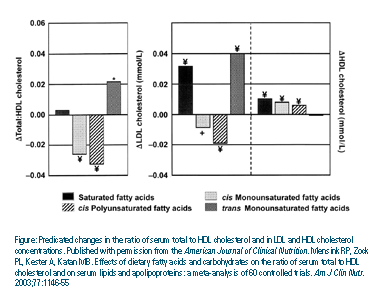
A key meta-analysis of controlled trials showed that, when TFAs replace carbohydrates as an energy source, low- density lipoprotein cholesterol (LDL-C) rises while high-density lipoprotein cholesterol (HDL-C) does not. That, in turn, increases the serum total cholesterol to HDL-C ratio (Figure).8 Subsequent research demonstrated similar findings1,9 and further showed that TFAs increased apolipoprotein B (apoB) and lipoprotein(a) [Lp(a)] levels while lowering HDL-C and apolipoprotein A-1 (apo A-1) levels even when compared to SFAs.10 Other studies have suggested TFAs can be pro-inflammatory11-14 and associated with endothelial dysfunction when compared with SFAs.14-17 Controlled and observational studies also have linked TFAs to worsened insulin resistance, especially in predisposed individuals. Indeed, one study of about 84,000 women followed over 16 years reported a 40-percent increased risk of diabetes — after adjustment for other risk factors — for women who consumed the most compared to the least TFAs.18 Nonetheless, further research is needed before definitive, or cause-and-effect, relationships can be concluded.
Regulations
The U.S. Food and Drug Administration (FDA) required in January 2006 that manufacturers list the amount of TFAs per serving on the Nutrition Facts panel of packaged foods.1,19 Products containing <0.5 grams trans fat per serving could be labeled as 0 grams trans fat, despite the fact that the words “partially hydrogenated” may appear in the list of ingredients.1-2,20 A decline in the consumption of TFAs resulted as food manufacturers worked to reformulate products, however, evidence on current levels of trans fats in foods is limited.
A recent analysis of more than 4,000 packaged foods showed that almost 1 in 10 products contained PHOs and 84 percent of those labeled as containing 0 grams per serving contained TFAs.20 In June 2015, the FDA determined that TFAs are not “generally recognized as safe” for consumption and gave manufacturers a three-year period in which to remove them from all commercially prepared foods.21
Recommendations and Conclusions
The American Heart Association (AHA) recommends limiting trans fats to <1 percent and saturated fat between 5 to 6 percent of total calories; based on a 2,000-calorie diet that is equivalent to a daily intake of about 2 grams and 12 grams, respectively.19,22 Trans fats became more widely used as a strategy for replacing saturated fat in the diet. Studies have shown, however, that trans fats are far more detrimental compared to saturated fat in regard to cardiovascular health. Using butter as a substitute for margarine is not advised because butter is almost 70 percent saturated and contains 7.5 grams saturated fat per tablespoon. The following are recommended dietary strategies to reduce TFAs22:
- Use any unsaturated vegetable oil such as canola, safflower, sunflower, or olive oil most often; dip a pastry brush in oil and use as a spread;
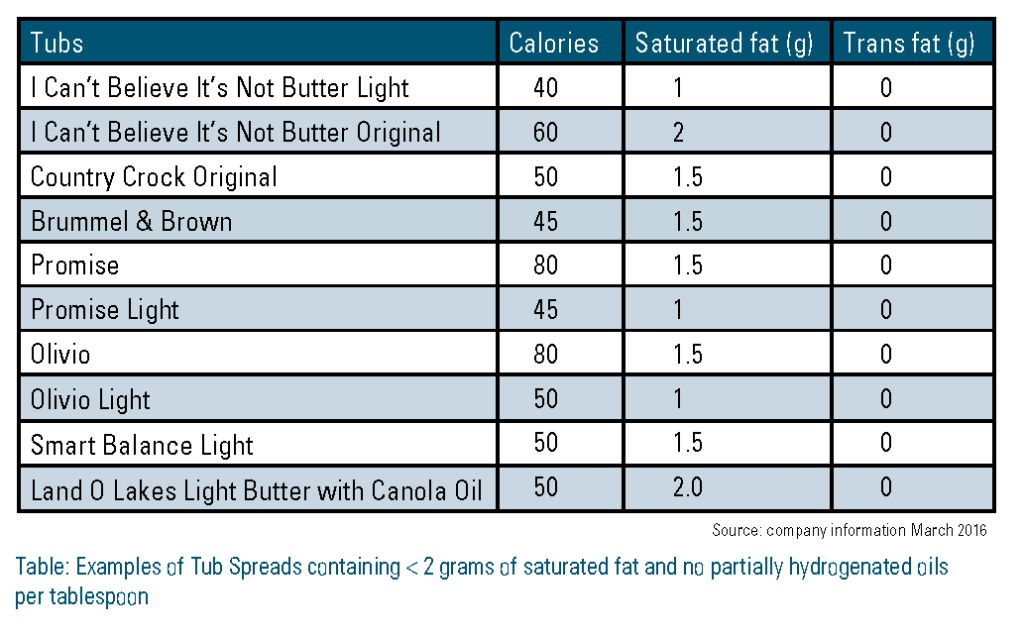
- Choose a liquid or soft, reformulated tub of margarine over harder stick forms (Table);
- Look for “0 grams trans fat” on the nutrition label and the absence of hydrogenated oils in the ingredient list;
- Limit consumption of commercially fried and baked goods.
Although the average dietary intake of industrially produced TFAs in the U.S. has declined,2,23 many people are likely eating amounts in excess of the recommendations because of current labeling laws.19 Since the FDA has ruled that trans fats are not “generally recognized as safe” they should be eliminated from the food supply in the coming years. Individuals with dyslipidemia should not go back to using stick butter since it is higher in saturated fat than many tub margarine spreads or vegetable oils in today’s market. The use of even a small amount of butter is unlikely to fit into a dietary pattern that meets the current AHA guidelines for saturated fat.
Disclosure statement: Frances Burke has no disclosures to report. Lauren Kelley-Chew has no disclosures to report.
References:
- Mozaffarian D, Katan MB, Ascherio A, Stampfer MJ, Willett WC. Trans fatty acids and cardiovascular disease. N Engl J Med. 2006;354:1601-1613.
- Lichtenstein AH. Dietary trans fatty acids and cardiovascular disease risk: past and present. Curr Atheroscler Rep. 2014;16:433-439.
- American Heart Association. Policy position statement on regulatory and legislative efforts to improve cardiovascular health by decreasing consumption of industrially produced trans fats. Available at: https://www.heart.org/idc/groups/heart-public/@wcm/@adv/documents/downloadable/ucm_428435.pdf. Accessed March 1, 2016.
- Eckel RH, Borra S, Lichtenstein AH, Yin-Piazza SY. Understanding the complexity of trans fatty acid reduction in the American diet. American Heart Association trans fat conference 2006: Report of the trans fat conference planning group. Circulation. 2007;115:2231-2246.
- Mozaffarian D, Aro A, Willett WC. Health effects of trans-fatty acids: experimental and observational evidence. European Journal of Clinical Nutrition. 2009;63:S5-S21.
- Bendsen NT, Christensen R, Bartels EM, Astrup A. Consumption of industrial and ruminant trans fatty acids and risk of coronary heart disease: a systematic review and meta-analysis of cohort studies. European Journal of Clinical Nutrition. 2011;65:773-83.
- Oh K, Hu FB, Manson JE, Stampfer MJ, Willett WC. Dietary fat intake and risk of coronary heart disease in women: 20 years of follow-up of the Nurses’ Health Study. Am J Epidemiol. 2005;161:672-679.
- Mensink RP, Zock PL, Kester AD, Katan MB. Effects of dietary fatty acids and carbohydrates on the ratio of serum total to HDL cholesterol and on serum lipids and apolipoproteins: a meta-analysis of 60 controlled trials. Am J Clin Nutr. 2003;77:1146-1155.
- Sun Q, Ma J, Campos H, et al. A prospective study of trans fatty acids in erythrocytes and risk of coronary heart disease. Circulation. 2007;115:1858-1865.
- Mozaffarian D, Clarke R. Quantitative effects on cardiovascular risk factors and coronary heart disease risk of replacing partially hydrogenated vegetable oils with other fats and oils. Eur J Clin Nutr. 2009;63(Suppl 2):S22-S33.
- Bendsen NT, Stender S, Szecsi PB, et al. Effect of industrially produced trans fat on markers of systemic inflammation: evidence from a randomized trial in women. J Lipid Res. 2011;52:1821-1828.
- Mozaffarian D, Pischon T, Hankinson SE, et al. Dietary intake of trans fatty acids and systemic inflammation in women. Am J Clin Nutr. 2004;79:606-612.
- Mozaffarian D, Rimm EB, King IB, et al. Trans fatty acids and systemic inflammation in heart failure. Am J Clin Nutr. 2004;80:1521-1525.
- Lopez-Garcia E, Schulze MB, Meigs JB, et al. Consumption of trans fatty acids is related to plasma biomarkers of inflammation and endothelial dysfunction. J Nutr. 2005;135:562-566.
- Baer DJ, Judd JT, Clevidence BA, Tracy RP. Dietary fatty acids affect plasma markers of inflammation in healthy men fed controlled diets: a randomized crossover study. Am J Clin Nutr. 2004;79:969-973.
- de Roos NM, Bots ML, Katan MB. Replacement of dietary saturated fatty acids by trans fatty acids lowers serum HDL cholesterol and impairs endothelial function in healthy men and women. Arterioscler Thromb Vasc Biol. 2001;21:1233-1237.
- de Roos NM, Slebelink E, Bots ML, van Tol A, Schouten EG, Katan Mb. Trans monounsaturated fatty acids and saturated fatty acids have similar effects on postprandial flow-mediated vasodilation. Eur J Clin Nutr. 2002;56:674-679.
- Hu FB, Manson JE, Stampfer MJ, et al. Diet, lifestyle, and the risk of type 2 diabetes mellitus in women. N Engl J Med. 2001;345:790-797.
- Remig V, Franklin B, Margolis S, Kostas G, Nece T, Street JC. Trans fats in America: A review of their use, consumption, health implications, and regulation. J Am Diet Assoc. 2010;110:585-592.
- Clapp J, Curtis CJ, Middleton AE, Goldstein GP. Prevalence of partially hydrogenated oils in U.S. packaged foods, 2012. Prev Chronic Dis. 2014;11:140161.
- American Heart Association. American Heart Association praises FDA action on trans fat. Available at: http://newsroom.heart.org/news/american-heart-association-praises-historic-fda-action-to-remove-trans-fat-from-foods. Accessed March 1, 2016.
- American Heart Association. Trans Fats. Available at: http://www.heart.org/HEARTORG/HealthyLiving/HealthyEating/Nutrition/Trans-Fats_UCM_301120_Article.jsp#.VtW5gcv2bbg. Accessed February 9, 2016.
- Dietz WH, Scanlon KS. Eliminating the use of partially hydrogenated oil in food production and preparation. JAMA. 2012;308:143-144.