




.jpg)
.png)






Fall 2013 LipidSpin Articles
 Matthew K. Ito, PharmD, CLS, FNLA |
From the NLA President: Spreading the WordAs a teen, I did all the things other 14-year-old boys did: played sports, hung out with friends, and raced dirt bikes. But around that time I learned I inherited a genetic disorder called Familial Hypercholesterolemia (FH). When I was diagnosed with FH in 1974, the medical community didn’t have ideal guidance or treatment for it, especially for children and teens. In fact, I wasn’t treated for FH until my late 20s, just after statins were introduced. The only thing... more |
 Ralph La Forge, MSc, CLS, FNLA  Paul E. Ziajka, MD, PhD, FNLA |
From the Chapter President and Immediate Past-President: Statin IntoleranceThe SELA board decided to devote this issue of Lipid Spin to the problem of statin intolerance. In formal clinical trials statin intolerance is reported in 2 to 3 percent of study subjects, but longer term follow up studies report a more realistic rate of 15 to 20 percent. In an informal survey of the past-president's (PZ) private practice lipid clinic 24 of the most recent 30 new patients were referred because of statin intolerance. The most common problems reported by... more |
 ROBERT A. WILD, MD, PhD, MPH, FNLA |
Letter From the Lipid Spin Editors: NLA CME: A Culture of Policing OurselvesLipid Spin is but one NLA educational offering. As editors we are pleased to bring these issues to clinicians on a regular basis. Lipid Spin is peer reviewed. The subject matter is always trying to address how we can better take care of the patients/clients we serve. Our focus is prevention. Because we are always trying to prevent ravages of CVD for everyone, by definition some of what we offer will always be useful for some and not useful for others. We need to remind... more |
 Demir Baykal, MD, FACC, FASE, CCT |
Clinical Feature: An Update on Statin Safety with an Emphasis on Differences
|
 Mary Honkanen, MD, ABIM, FNLA |
Guest Editorial: Managing the Statin-Intolerant Patient: Low-Dose/Low-Frequency Treatment RegimensA patient recently told me the story of her statin-intolerant sister, who was referred to a cardiologist she had seen for chest pain a few years earlier. When he entered the room, she explained that she could hardly walk or even get out of bed on atorvastatin. The doctor simply stated there was nothing he could do for her and walked out, leaving her confused and hurt. We can do something for these patients and it starts with listening. Statin clinical trials suggest... more |
 Jennifer M. Welding, PharmD, CTTS  Bishoy Ragheb, PharmD, BCACP, CDE, CTTS |
EBM Tools for Practice: Evidence-Based Approach to the Use of CoQ10 to Deal with Statin IntoleranceStatins reportedly are the most effective of the lipid-modifying drugs in primary and secondary prevention of coronary heart disease.1-6 Yet, many patients are deprived of the benefits of statins because of their associated complications. The most common statin-related complication is myopathy, which was underreported in clinical trials because of the exclusion of patients with a previous history of myalgia.1,7,8 Studies specifically designed to assess the rate of... more |
 CASEY ELKINS, DNP, NP-C, CLS |
Lipid Luminations: Lowering LDL Using Non-Statin RegimensAlthough statin therapy is a cornerstone of cardiovascular disease prevention, and although it achieves the largest reduction of low-density lipoprotein (LDLC), 1 and has one of the safest overall side-effect profiles among lipid-lowering medications, some patients are unable to tolerate statins because of one or more side effects. When this clinical scenario is present, alternative risk-reduction strategies are needed to achieve target LDL-C goals. Clinicians should be familiar... more |
 JESSICA LILLEY, MD |
Specialty Corner: Tolerability of Statin Therapy in ChildrenThe National Heart, Lung and Blood Institute (NHLBI) recommends universal pediatric lipid screening to identify and treat children with serious genetic dyslipidemias.1 Primary care providers should certainly identify children who will be candidates for statin therapy. One in 500 people are heterozygous for the autosomal co-dominant mutations causing familial hypercholesterolemia2 (FH), making it one of the most common genetic diseases in Western populations. Still, a... more |
 DEBRA A. FRIEDRICH, DNP, ARNP, FNP-BC, FNLA |
Practical Pearls: Vitamin D Deficiency and Statin IntoleranceStudies specifically designed to evaluate prevalence of statin-related myalgia have shown that approximately 22% of patients on statins have some degree of musculoskeletal pain.1 As clinicians, we know it is difficult for patients to discern between pain related to statin intolerance and that associated with aging, osteoarthritis or autoimmune disorders. Many patients with these symptoms discontinue their statin medication without consulting their primary care provider. This... more |
 NICOLE GASKINS GREYSHOCK, MD  JOHN R. GUYTON, MD |
Case Study: Muscle-Related Statin IntoleranceOur patient is a 67-year-old African American female referred to the Duke Lipid Clinic for hypercholesterolemia and elevated creatine kinase (CK). She has a history of coronary heart disease with a prior non ST-elevation myocardial infarction (NSTEMI) and stent placement. She has a former 40-packs-a-year smoking history, hypertension, lumbar degenerative disk disease and constipation. She had lower extremity muscle pain with atorvastatin with elevated CK in the low 300s (reference 20-200 U/L... more |
 BARBARA S. WIGGINS, PharmD, BCPS, CLS, FNLA, FCCP, FAHA, AACC |
Member Spotlight: Barbara S. Wiggins, PharmDFor Barbara Wiggins, PharmD, a typical work day involves working up patients, managing medication reconciliation, verifying doses, compliance, and completing rounds as a member of an interdisciplinary health care team. Her spare time is divided into providing input on patient management, counseling and teaching. Before she became a clinical pharmacy specialist in cardiology, Dr. Wiggins had deferred going into clinical practice and served in the United states Navy for 6 years. She... more |
 ANNE C. GOLDBERG, MD, FNLA |
Foundation UpdateSeptember is National Cholesterol Education Month. In recognition of this, the Foundation of the NLA has supported an important campaign called “ARE YOU THE ONE?” To help call attention to familial hypercholesterolemia (FH), the Foundation has provided two copies of a poster and handout to all NLA members and more than 40,000 members of the American Academy of Family Physicians. This campaign furthers one of our priorities: to educate clinicians— especially primary care... more |
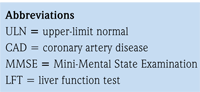 Statin drugs have been studied in numerous controlled trials involving hundreds of thousands of study participants. Their use has resulted in reduced coronary artery disease (CAD) mortality, morbidity and, in several studies, all-cause mortality. Even though clinical trial evidence and clinical practice experience have demonstrated...